
Parents often ask me about the Algebra 2 Regents once their child finishes Geometry. Does my child have to take it? What is on it? And what score do they need?
Here is the short answer.
The Algebra II Regents is a New York State exam on the Algebra II course. It is not required for a standard Regents diploma. But students aiming for the Regents diploma with advanced designation generally need it, because that diploma requires three math exams.
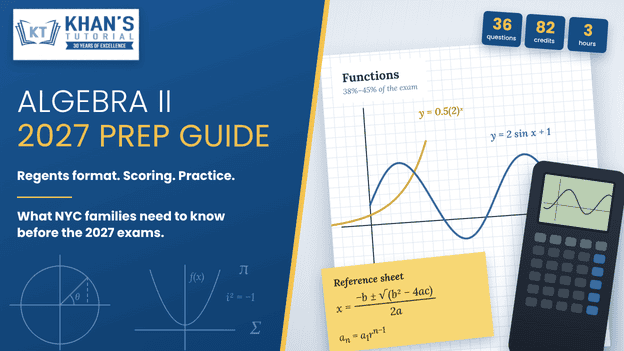
The exam changed in June 2026. It now has 36 questions worth 82 credits, and students get three hours. A scale score of 65 is the usual passing mark. The best free practice comes straight from New York State.
Below, I explain the new format, the reference sheet, how scoring works, and the study plan I give families.
Table of Contents
- What Is the Algebra II Regents, and Who Takes It?
- Why do families choose this exam?
- When Is the Algebra II Regents Given?
- What Is the Format of the Algebra II Regents?
- What Is on the Algebra II Reference Sheet?
- What Topics Are on the Exam?
- How Is the Algebra II Regents Scored?
- Where Can You Find Free Official Practice?
- Conclusion
- Frequently Asked Questions
What Is the Algebra II Regents, and Who Takes It?
The Regents exams are New York State tests in high school subjects. New York offers three math Regents exams: Algebra I, Geometry, and Algebra II. For an overview of all three, see our guide to the math Regents exams.
Students generally must complete the Algebra II course before they take the Algebra II Regents.
Does my child need Algebra II Regents to graduate?
Not for a standard diploma. Under NYSED’s current graduation requirements, a Regents diploma requires passing one math Regents exam (or a state-approved alternative).
The Regents diploma with advanced designation is different. It requires three math Regents exams or approved alternatives. Since New York offers only three math Regents, a student seeking the advanced designation needs Algebra II unless they use an approved alternative.
New York is also changing its graduation rules. As of November 2026, NYSED says it is not eliminating the Regents exams, and the existing requirements remain in effect for all students until changes are approved.
Why do families choose this exam?
In my experience, students usually take Algebra II in 10th or 11th grade, after Algebra I and Geometry. Families choose it for a few reasons:
- The advanced designation. After Algebra I and Geometry, Algebra II is the only math Regents left.
- College readiness. In my view, Algebra II is a strong base for math in college.
- SAT math. Many skills overlap, which I explain in the FAQ below.
Many students find Algebra II the hardest of the three math Regents. That is my observation, not an official ranking. It covers more topics, and the problems often take more steps.
When Is the Algebra II Regents Given?
NYSED has published these 2027 testing periods. Algebra II appears on all three 2027 schedules:
| Administration | Testing period | Algebra II on the schedule? |
|---|---|---|
| January 2027 | January 26–29, 2027 | Yes |
| June 2027 | June 15–25, 2027 | Yes |
| August 2027 | August 17–18, 2027 | Yes |
In my experience, most students take it in June, at the end of the course.
The exact day and time are in the schedules on NYSED’s Regents examination schedules page. NYSED tells students to confirm their report times with their school, so always check with your child’s school.
What Is the Format of the Algebra II Regents?
What changed in June 2026?
The Algebra II Regents now follows New York’s Next Generation math standards. The first exam in this new version was given in June 2026. January 2026 was the last exam in the old version.
This matters for practice. The January 2026 exam had 37 questions worth 86 credits. Today’s exam has 36 questions worth 82 credits. Many study guides and past exams online still show the old version.
The current format
Here is the format, from NYSED’s Algebra II Educator Guide:
| Part | Question type | Number of questions | Credits each | Total credits |
|---|---|---|---|---|
| Part I | Multiple choice | 24 | 2 | 48 |
| Part II | Constructed response | 8 | 2 | 16 |
| Part III | Constructed response | 3 | 4 | 12 |
| Part IV | Constructed response | 1 | 6 | 6 |
| Total | 36 | 82 |
A few terms to explain:
- Multiple choice questions have four answer choices. Students pick one.
- Constructed response means your child writes out the answer and shows the steps. Some questions also ask for a written explanation. Math teachers score these with NYSED’s rating guide, and partial credit is possible.
- Credits are the points a student earns. All the credits added together make the raw score. The highest raw score is 82.
Students have three hours to finish the exam.
What about the calculator?
Every student must have a graphing calculator for the whole exam. Calculators that can do “symbol manipulation” (solve the algebra for you) are not allowed. A straightedge (ruler) must also be available.
NYSED’s graphing calculator guidelines say a calculator’s memory must be cleared, reset, or disabled when students enter the testing room. Each student may use only one calculator. Schools are responsible for supplying the right tools, so ask your child’s school whether to bring their own.
What Is on the Algebra II Reference Sheet?
The reference sheet is a page of formulas. NYSED includes a detachable copy at the end of the test booklet. It lists formulas students are expected to use, but not necessarily memorize.
The Next Generation Algebra II reference sheet is posted free on NYSED’s website. In plain English, it includes:
- The quadratic formula
- Trigonometry identities
- Formulas for factoring a sum or difference of two cubes
- Probability rules, including conditional probability
- Formulas for arithmetic and geometric sequences and series
- Exponential growth and decay formulas, including compound interest
I recommend printing it and using it every time your child practices. Knowing where each formula sits saves time on test day.
What Topics Are on the Exam?
NYSED groups the exam into four content areas. Here is roughly how much of the test each area covers, measured by credits:
| Content area | Share of the exam | What it means in plain words |
|---|---|---|
| Functions | 38%-45% | Reading and building functions, exponential models, and trigonometric functions |
| Algebra | 30%-39% | Working with polynomials and rational expressions, and solving equations and inequalities |
| Statistics and Probability | 14%-22% | Interpreting data, drawing conclusions from data, and conditional probability |
| Number and Quantity | 4%-8% | Real numbers and complex numbers |
A function is a rule that turns one number into another. A complex number includes the imaginary unit i, the square root of −1.
The takeaway for parents: functions and algebra make up most of the exam. Statistics and probability also carry real weight, so don’t let your child skip them.
How Is the Algebra II Regents Scored?
Raw score and scale score
First, your child earns a raw score: the total credits from all 36 questions, out of 82.
Then the raw score is turned into a scale score from 0 to 100. This is the final score your child sees. NYSED publishes a conversion chart for each exam that shows which raw score matches which scale score.
The chart changes from one exam to the next. NYSED states that each chart is usable only for that one administration. NYSED posts each chart on or after the day of that exam.
Real examples from 2026
| Administration | Raw score needed for a 65 | Raw score needed for an 85 | Highest raw score |
|---|---|---|---|
| January 2026 (old version) | 26 | 64 | 86 |
| June 2026 (new version) | 30 | 64 | 82 |
| August 2026 (new version) | 30 | 66 | 82 |
Only compare charts from the same version. The January 2026 chart had more total credits, so it isn’t a direct match for today’s exam.
Which scores matter most?
- 65 is the usual passing score. NYSED’s appeal rules describe a score of 60–64 as “no more than five points below passing.” On the 2026 charts, 65 is also the start of Level 3. Some students may have other options, such as appeals or safety nets, under NYSED rules.
- 85 or higher counts toward the “mastery in mathematics” diploma endorsement. That endorsement generally requires scores of 85 or higher on three math Regents exams. On the 2026 charts, 85 is also the start of Level 5, the highest level.
I never recommend aiming for the minimum. Nobody knows the chart in advance, and a student aiming for 65 has no room for a bad morning.
When results come out, our post on how to check your Regents scores explains where to look.
Where Can You Find Free Official Practice?
NYSED posts past Algebra II Regents exams for free at nysedregents.org/algebratwo. For each recent exam, you’ll find:
- The exam itself
- The scoring key, with the multiple-choice answers
- The rating guide, which shows how teachers score the written answers
- A model response set, extra scoring guidance that schools use alongside the rating guide
- The conversion chart
Only the June 2026 and August 2026 exams match the new format. Older exams still help with practice on specific skills, but their structure and scoring are different.
Our list of free Regents prep resources for NYC students collects more options in one place.
How should your child use past exams?
The biggest mistake I see is doing questions one at a time and never sitting a full exam. Here is the plan I recommend for the last four to six weeks:
- Take one full exam under real conditions. Three hours, a graphing calculator, the reference sheet, and no phone.
- Score it honestly. Use the scoring key for Part I. Use the rating guide and model responses for the written answers. Then use that exam’s conversion chart.
- Find where the credits went. Which part lost the most? Which topics? Were the mistakes careless or real gaps?
- Re-work the weak topics. Older exams are useful here, one topic at a time.
- Repeat with another exam. Save the most recent new-format exam for last.
Because only two new-format exams exist so far, I suggest using them carefully. Don’t spend them in the first week.
Conclusion
The Algebra II Regents is a three-hour exam with 36 questions worth 82 raw credits. That format began in June 2026. A scale score of 65 is the usual passing mark, and 85 or higher counts toward mastery. The raw score needed changes with every exam.
It isn’t required for a standard diploma. Students seeking the advanced designation generally need it unless they use an approved alternative. The best preparation is free: official past exams, the reference sheet, and NYSED’s own scoring materials.
Frequently Asked Questions
Is the Algebra II Regents required to graduate?
Not for a standard Regents diploma, which requires one math Regents. The Regents diploma with advanced designation requires three math Regents exams or approved alternatives, so a student seeking it needs Algebra II unless they use an approved alternative.
What score is passing on the Algebra 2 Regents?
A scale score of 65 is the usual passing score. The raw score needed changes with each exam. It was 30 out of 82 in both June and August 2026.
Can my child retake it?
Yes. Students can take it again at a later administration. NYSED’s appeal rules even require some students to have taken an exam at least twice. Our guide on how to recover from a failed Regents exam walks through next steps.
Does my child get a reference sheet?
Yes. A detachable reference sheet is included at the end of the test booklet. Practice with the Next Generation version so it feels familiar.
How is it different from Algebra I?
Both exams last three hours and are worth 82 credits. Algebra II adds topics such as trigonometric functions and complex numbers. For comparison, see our Algebra I Regents conversion chart guide.
Does Algebra II help with SAT math?
It can. The SAT Math section includes an area College Board calls Advanced Math, which covers nonlinear equations and nonlinear functions. Algebra II spends a lot of time on those skills. No single course guarantees a particular SAT score, though.
If your child is preparing for the January or June Algebra II Regents and would benefit from steady, structured practice, Khan’s Tutorial’s Regents group classes are a good next step.