
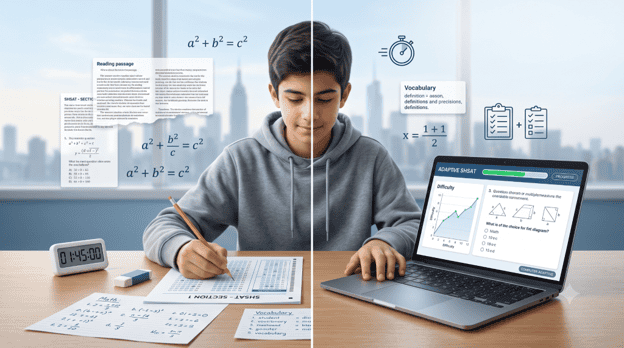
The Specialized High Schools Admissions Test (SHSAT) remains one of the most competitive entrance exams for New York City’s specialized high schools. Every year, thousands of eighth graders prepare for this challenging assessment with the goal of earning admission to schools such as Stuyvesant High School, Bronx High School of Science, and Brooklyn Technical High School.
As technology continues to shape standardized testing, many parents ask an important question: How does the computer-adaptive format impact the SHSAT? Understanding the differences between a traditional paper-based exam and a computer-adaptive assessment helps students develop flexible test-taking skills that prepare them for future testing environments.
As the SHSAT is currently administered in a computer-adaptive format, learning the strategy differences between paper and computer-adaptive testing can strengthen overall preparation and improve confidence.
Parents often wonder whether the testing format changes how students should prepare. The answer is yes. While strong math, reading, and revising/editing skills remain essential, the way students manage time, review answers, and approach questions differs significantly between paper-based and computer-adaptive exams.
This guide explains the major strategic adjustments that every NYC eighth grader should understand.
Table of Contents
- Understanding Paper SHSAT vs. Computer-Adaptive Testing
- How Test-Taking Strategy Changes Between Formats
- Time Management Adjustments Students Must Make
- Study Techniques That Prepare Students for Either Format
- Common Mistakes Parents and Students Should Avoid
- How I Help Students Build Flexible SHSAT Skills
- Conclusion
- Frequently Asked Questions
Understanding Paper SHSAT vs. Computer-Adaptive Testing
The SHSAT has transitioned from a traditional paper-based format to a computer-adaptive exam. In the past, students used test booklets where they could answer questions in any order, skip difficult questions temporarily, and return to previous questions before submitting their answer sheet.
A computer-adaptive test works differently. The testing software selects future questions based on previous responses. Correct answers generally lead to more challenging questions, while incorrect answers may result in easier ones. Most adaptive exams also limit or completely prevent students from revisiting earlier questions after moving forward.
These structural differences require students to rely less on traditional paper-based habits and more on careful decision-making during each question. As the SHSAT is now computer-adaptive, practicing adaptive-style thinking develops stronger problem-solving skills and prepares students for many future standardized exams.
How Test-Taking Strategy Changes Between Formats
Students cannot simply use the same approach in both testing environments. Several adjustments become important.
Paper SHSAT Strategy
- Skip difficult questions and return later.
- Circle important information directly in the test booklet.
- Eliminate answer choices with handwritten notes.
- Estimate remaining time by counting unanswered questions.
- Double-check completed work before submitting.
Computer-Adaptive Strategy
- Read every question carefully before answering.
- Make each response count because future questions depend on previous answers.
- Develop confidence without relying on answer review.
- Maintain steady pacing instead of rushing difficult questions.
- Learn to solve problems mentally with limited note-taking opportunities.
The biggest adjustment involves decision-making. Students must feel comfortable committing to an answer rather than expecting to revisit it later.
Time Management Adjustments Students Must Make
Time management becomes even more important when testing formats differ.
For the paper SHSAT, many students divide the section into smaller time blocks, answer easier questions first, and revisit challenging problems near the end. This flexible pacing often improves efficiency because students maximize the number of completed questions.
Computer-adaptive testing demands a steadier rhythm. Since students generally cannot skip ahead or return later, they must balance careful reading with consistent progress. Spending too much time on one question can create unnecessary pressure throughout the remainder of the exam.
I encourage students to practice solving problems within realistic time limits while maintaining accuracy. Building this discipline helps students succeed regardless of future testing formats. Instead of depending on review opportunities, students learn to trust their reasoning and avoid second-guessing themselves.
Parents can reinforce these habits by encouraging timed practice sessions that focus equally on accuracy, pacing, and confidence.
Study Techniques That Prepare Students for Either Format
Students who build adaptable skills perform well regardless of testing format.
Strengthen Core Academic Skills
- Practice advanced reading comprehension.
- Improve vocabulary through consistent reading.
- Master algebraic reasoning and arithmetic fluency.
- Develop logical thinking across multiple question types.
Simulate Different Testing Environments
- Complete traditional paper practice tests.
- Practice digital assessments when available.
- Work under realistic testing time limits.
- Alternate between printed and screen-based reading.
Improve Decision-Making
- Limit unnecessary answer changes.
- Learn when to move forward confidently.
- Review mistakes after practice exams.
- Identify recurring patterns of errors.
Build Mental Endurance
- Practice full-length exams.
- Reduce distractions during study sessions.
- Improve concentration over extended periods.
- Develop consistent testing routines before exam day.
Flexible preparation creates adaptable students who remain confident regardless of how future assessments evolve.
Common Mistakes Parents and Students Should Avoid
Several habits can reduce performance even when students know the material.
Waiting Too Long to Prepare
- Strong SHSAT preparation typically requires several months of consistent study.
- Last-minute cramming rarely develops advanced reasoning skills.
Focusing Only on Memorization
- The SHSAT measures critical thinking rather than simple recall.
- Students should understand concepts instead of memorizing procedures.
Ignoring Digital Testing Skills
- Many standardized exams now include computer-based components.
- Basic keyboard familiarity and screen-reading practice improve comfort.
Practicing Without Reviewing Mistakes
- Every incorrect answer provides valuable learning opportunities.
- Students should understand why they missed a question.
Allowing Anxiety to Control Performance
- Confidence grows through repeated practice.
- Familiar routines reduce stress before test day.
Parents who encourage steady preparation instead of perfection often help students build stronger long-term confidence.
How I Help Students Build Flexible SHSAT Skills
Every student learns differently. Some struggle with pacing, while others lose confidence after encountering difficult questions. My approach focuses on identifying these individual challenges early and creating personalized strategies that strengthen both academic skills and test-taking habits.
I begin by evaluating a student’s current performance in mathematics, reading comprehension, and revising/editing. From there, I develop targeted practice plans that improve weak areas while reinforcing existing strengths. I also introduce students to different testing environments so they become comfortable solving problems on paper and on digital platforms.
Parents frequently ask whether practicing computer-based skills matters if the SHSAT remains paper-based. I believe the answer is yes. Students who adapt easily to different formats often demonstrate greater confidence, stronger focus, and improved decision-making across many standardized exams they will encounter throughout high school and college admissions.
Most importantly, I emphasize consistency over intensity. Small daily improvements produce lasting results far more effectively than occasional marathon study sessions.
Conclusion
Preparing for the SHSAT involves much more than mastering academic content. Students also need effective strategies that match the testing environment. With the SHSAT now a computer-adaptive examination, understanding the differences between traditional and computer-adaptive testing helps students become more flexible, confident, and prepared for future academic assessments.
Parents can support this process by encouraging steady practice, realistic expectations, and strong problem-solving habits. Students who combine solid academic preparation with adaptable testing strategies place themselves in an excellent position for long-term success.
Frequently Asked Questions
1. Is the SHSAT computer-adaptive?
Yes. The SHSAT is currently administered as a computer-adaptive exam, where the difficulty of questions adjusts based on a student’s performance.
2. Why should students practice computer-based testing skills?
Many standardized assessments now use digital formats. Developing computer-testing skills improves confidence and prepares students for future academic exams.
3. Can students skip questions on the computer-adaptive SHSAT?
Generally, no. In a computer-adaptive format, students must usually commit to an answer before the software can select the next question, meaning they cannot skip and return later.
4. What is the biggest difference between paper and computer-adaptive testing?
Paper exams usually allow students to review and change answers, while computer-adaptive tests often require students to commit to each answer before moving to the next question.