
Parents often ask me about CUNY vs SUNY as soon as a college list starts to take shape. Both are public. Both are in New York. So what is the actual difference?
Here is the short answer. CUNY is New York City’s public university, and its colleges are all in the five boroughs. SUNY is the state’s public university, with campuses all over New York State.
Neither system is “better.” The right choice depends on your child: the program they want, your budget after aid, whether they will live at home, and how selective a campus they are aiming for.
This guide walks through each difference and ends with a short set of questions your family can answer together.
Table of Contents
- What Are CUNY and SUNY?
- Should Your Child Live at Home or Go Away?
- Why Does CUNY Often Cost NYC Families Less?
- What Financial Aid Works at Both?
- What About Programs and Honors Colleges?
- How Do the Applications Work?
- Do CUNY and SUNY Require the SAT or Look at Regents Scores?
- Can Students Transfer Between Them?
- How Should Your Family Decide?
- Conclusion
- Frequently Asked Questions
What Are CUNY and SUNY?
CUNY stands for the City University of New York. It has 26 colleges across New York City’s five boroughs: 11 senior colleges (four-year colleges), 7 community colleges (two-year colleges), and 8 graduate, honors and professional schools.
SUNY stands for the State University of New York. It has 64 campuses in four categories: university centers and doctoral institutions, university colleges, technology colleges, and community colleges. Not every SUNY campus is upstate. SUNY Maritime College, for example, is in the Bronx.
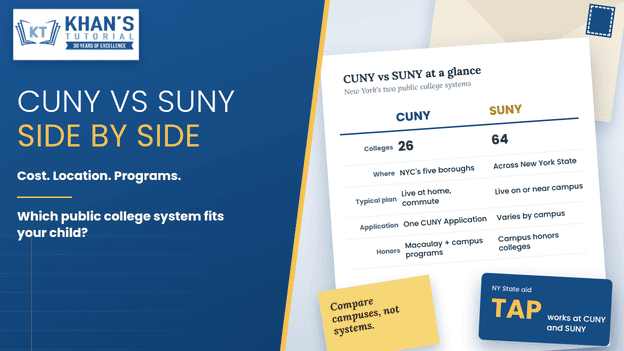
Here is a quick side-by-side view.
| CUNY | SUNY | |
|---|---|---|
| Where | 26 colleges in NYC’s five boroughs | 64 campuses across the state |
| Typical plan for an NYC student | Live at home and commute | Live on or near campus, unless the campus is close to home |
| Application | One CUNY Application covers up to 6 CUNY colleges | Varies by campus (for example, the SUNY Application or the Common App) |
| Honors | Macaulay Honors College at 8 campuses, plus honors programs at every college | Honors colleges run by individual campuses |
| NY State aid | TAP and Excelsior (currently closed) | TAP and Excelsior (currently closed) |
Should Your Child Live at Home or Go Away?
For most NYC families, this is the biggest real difference. It shapes cost and daily life more than anything else.
Because every CUNY college is in the city, most NYC students can live at home and take the subway or bus to class. Some CUNY colleges do have housing. Lehman College in the Bronx, for example, opened its first student dormitory, The Lehman Grand, ahead of the fall 2026 semester.
Choosing a SUNY campus upstate or on Long Island usually means choosing for your child to live away from home. That means a room, a meal plan, and trips home on breaks.
Neither is wrong. Some students do best with the structure of home. Others grow a lot from living on campus. I encourage parents to be honest about which one fits their child.
Why Does CUNY Often Cost NYC Families Less?
Both systems are public. CUNY lists a lower tuition rate for New York State residents, and SUNY campuses such as Cortland do the same.
The difference usually comes from housing, not tuition. CUNY’s own student budget page splits costs into two groups: students living at home or with relatives, and students living away from home. The living-away budget includes housing and medical costs, and its total is much higher.
CUNY’s Comparing College Costs page makes a point I agree with: “Families often make the mistake of calculating only tuition and room and board.” It recommends filling out a cost worksheet for each school your child is considering.
For SUNY, start with SUNY’s Tuition and Fees page, then check each campus’s own cost page. Prices change every year, so I don’t quote them here.
What Financial Aid Works at Both?
Two New York State programs, run by the Higher Education Services Corporation (HESC), can be used at both CUNY and SUNY.
- TAP (Tuition Assistance Program). TAP helps pay tuition for eligible New York residents at approved colleges in New York State. HESC says it “does not have to be paid back.” CUNY notes that students must reapply for TAP every year, along with the FAFSA (the federal financial aid form). HESC’s TAP page has the current rules.
- Excelsior Scholarship. HESC says Excelsior lets students from families under an income limit attend a “state-operated SUNY or CUNY college tuition-free.” As of October 2026, HESC lists these conditions: students must study full time and complete at least 30 credits a year. Afterward, they must live in New York State for as many years as they received the award, and work in New York if employed. HESC’s Excelsior page currently shows the program as closed for the 2026–27 academic year, so check it again for your child’s first year.
What About Programs and Honors Colleges?
Start with the major. Both systems are large, and not every campus offers every program. Look up your child’s intended major on each campus’s own site before you fall in love with a campus.
Both systems also include professional schools. CUNY has its own School of Medicine and School of Law. SUNY includes four medical schools, two dental schools and a law school.
Honors options look different in each system.
- CUNY: Macaulay Honors College is the honors college of CUNY. Macaulay students enroll as undergraduates at one of eight CUNY colleges. Macaulay says it offers all its students a merit scholarship package that includes tuition. Beyond Macaulay, CUNY says all of its four-year and community colleges offer honors programs.
- SUNY: Honors colleges belong to individual campuses. Stony Brook and the University at Buffalo, for example, each have their own Honors College.
If honors is on your child’s list, our post on Macaulay Honors vs. SUNY Binghamton goes deeper.
How Do the Applications Work?
CUNY uses its own CUNY Application, and one application lets a freshman apply to 6 CUNY colleges. SUNY campuses set their own options. SUNY Geneseo takes the Common App or the SUNY Application, and Stony Brook also accepts the Coalition application. Neither lists the CUNY Application. Many NYC seniors I work with apply to both systems. Deadlines differ by system and by campus. For CUNY dates, see our CUNY and Macaulay winter checklist. For the bigger picture, see How Do I Apply for College in NYC?
Do CUNY and SUNY Require the SAT or Look at Regents Scores?
Test-optional means your child can choose whether to send SAT or ACT scores. Policies are often stated by entry term, so check the exact term your child is applying for.
CUNY’s testing policy page says “CUNY is test optional for undergraduate admission,” and that not sending SAT or ACT scores “cannot be used to deny a student admission.” The page gives no end date. One line on CUNY’s main admissions page still says test-optional “through spring 2027,” so confirm the policy when your child applies.
On the SUNY side, SUNY’s testing requirements page says SUNY has temporarily suspended SAT and ACT requirements for students applying to its bachelor’s degree colleges. Some programs, merit scholarships and Division I athletes may still need scores, so check each campus. Stony Brook, for example, says it “is test optional for applicants” and lists fall 2027 as an entry term.
Regents scores can matter. Brooklyn College lists “New York State Regents examination results, if available” among the things it reviews. SUNY Maritime College lists Regents among the exam scores in its review. CUNY also requires all students to show proficiency in English and math, and benchmark scores on the SAT, ACT or Regents exams are one way to do that. Our guide to Regents exam scores explains how the scoring works.
Can Students Transfer Between Them?
Yes. Students move within and between the two systems.
Inside CUNY, the Pathways system means general education credits completed at one CUNY college carry over when a student transfers to another CUNY college.
Inside SUNY, Transfer Paths let a student start at a SUNY community college “while making guaranteed progress toward your bachelor’s degree in any SUNY four-year program offering the pathway.”
Moving from one system to the other is possible too. Both CUNY and SUNY campuses accept transfer applicants. I always tell families to ask the receiving college how credits will transfer before counting on any specific course.
How Should Your Family Decide?
I suggest sitting down together and answering these six questions.
| Question | Leans CUNY if… | Leans SUNY if… |
|---|---|---|
| Which program does your child want? | A CUNY college has it | A SUNY campus has it |
| Live at home or away? | Home | Away |
| What does it cost after aid? | Living at home keeps costs low | The aid offer covers living away |
| How selective a campus? | Compare individual campuses, not systems | Compare individual campuses, not systems |
| Is honors important? | Macaulay or a campus honors program fits | A campus honors college fits |
| How far from home? | Your child wants to stay close | Your child is ready for distance |
There is no wrong answer here. A family that fills this out honestly usually sees the right list take shape.
Conclusion
The SUNY vs CUNY question is really a question about your child. CUNY gives NYC students 26 colleges inside the city, usually with the option to live at home. SUNY offers 64 campuses across the state, usually with the experience of living away.
Both are public. Both accept New York State aid like TAP. Both have honors options. Compare the specific campuses, the specific program, and the real cost after aid. No choice of system guarantees admission or a particular outcome, but a clear plan makes the decision much calmer.
Frequently Asked Questions
1. What is the difference between CUNY and SUNY?
CUNY is New York City’s public university, with 26 colleges in the five boroughs. SUNY is New York State’s public university, with 64 campuses across the state.
2. Is CUNY or SUNY better?
Neither is better overall. It depends on your child’s program, budget, and whether they want to live at home or away.
3. Why is CUNY so cheap for NYC families?
Mostly because NYC students can live at home. CUNY’s own budget pages show that living away from home adds housing and other costs.
4. Is NYU a SUNY or CUNY school?
Neither. NYU is a private university.
5. Can you apply to both CUNY and SUNY?
Yes. They use separate applications, so your child applies to each one.
6. Do SUNY and CUNY look at Regents scores?
Some campuses, such as Brooklyn College and SUNY Maritime, list Regents results in their admissions review. CUNY also accepts Regents benchmark scores as one way to show English and math proficiency. See our Regents scores guide.
7. Can you transfer from CUNY to SUNY?
Yes. SUNY campuses accept transfer applicants. Ask the SUNY campus early how your child’s CUNY credits will transfer.
If your family is weighing CUNY and SUNY this year, Khan’s Tutorial’s college admissions program can help you plan the next steps, and you can ask about it using the form below.