
Parents often ask me, “What are the best SUNY schools?” My honest answer is that the best SUNY school depends on your child. It depends on the major they want, how far from home they want to be, and the kind of campus where they will do well.
What I can give you is a clear picture of which SUNY campuses are the hardest to get into, and what SAT scores their students have.
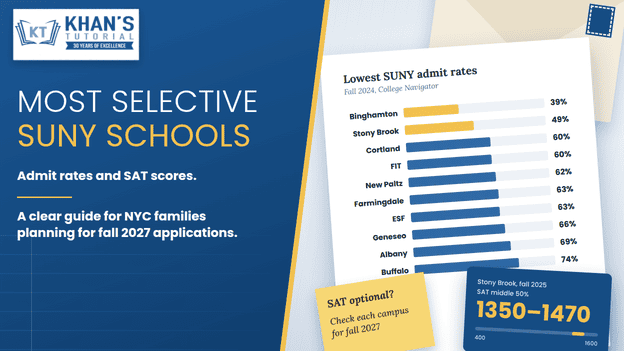
Here is the short answer. Using federal data for fall 2024, the SUNY campuses with the lowest admit rates were Binghamton (39%) and Stony Brook (49%). After them came a group of campuses that admitted roughly 60% to 70% of applicants: Cortland, the Fashion Institute of Technology (FIT), New Paltz, Farmingdale, ESF, Geneseo and Albany.
The SAT matters more at some of these campuses than others. When I checked in October 2026, every campus in this post told first-year applicants on its website that SAT scores are optional, with a few program exceptions. The details differ, so your child should check each campus before deciding whether to send a score.
No SAT score guarantees admission anywhere. But knowing these ranges can help your child set a realistic target.
Table of Contents
What Is SUNY, and What Are the “Big 4”?
SUNY is the State University of New York. It is New York’s public university system, with 64 campuses.
SUNY sorts its campuses into four groups: university centers and doctoral-degree-granting institutions, university colleges, technology colleges, and community colleges.
When families talk about the “big 4,” they usually mean SUNY’s four university centers: the University at Albany, Binghamton University, the University at Buffalo, and Stony Brook University. Binghamton’s own history notes that it was chosen as one of four doctorate-granting university centers in the SUNY system.
The “big 4” are not the only selective campuses, though. As you will see below, several other SUNY colleges admit a smaller share of applicants than Albany or Buffalo.
Which SUNY Schools Are Hardest to Get Into?
I looked up every SUNY campus that College Navigator lists as a four-year school and that reports an admit rate for first-year applicants. The table below lists the ones with the lowest admit rates for fall 2024. I ordered it by admit rate, from lowest to highest. That is the only measure I used. It is not a ranking of which school is “better.”
A few terms first:
- Admit rate is the share of applicants a college offered admission to.
- Middle 50% is the range covering the middle half of students’ scores. One quarter of students scored below the low number, and one quarter scored above the high number.
- The SAT has two sections, Reading and Writing and Math. Each is scored from 200 to 800, and the total score is the sum of the two.
All figures come from the U.S. Department of Education’s College Navigator, for fall 2024. I used one source and one year for every campus so the rows can be compared fairly. The SAT ranges describe first-year students who enrolled and sent an SAT score.
If you want to dig deeper, many colleges also publish a Common Data Set, a standard yearly report of admissions and enrollment numbers. Binghamton, for example, posts its own on its institutional research site.
Most selective SUNY campuses by admit rate (fall 2024)
| Campus | Admit rate | SAT Reading & Writing (middle 50%) | SAT Math (middle 50%) |
|---|---|---|---|
| Binghamton University | 39% | 670–740 | 670–760 |
| Stony Brook University | 49% | 650–730 | 680–770 |
| SUNY Cortland | 60% | Not reported | Not reported |
| Fashion Institute of Technology (FIT) | 60% | Not reported | Not reported |
| SUNY New Paltz | 62% | 600–690 | 570–650 |
| Farmingdale State College | 63% | 520–620 | 520–620 |
| SUNY ESF | 63% | Not reported | Not reported |
| SUNY Geneseo | 66% | 600–670 | 590–670 |
| University at Albany | 69% | Not reported | Not reported |
| University at Buffalo | 74% | 600–680 | 610–700 |
Notes on the table:
- Cortland and FIT both show 60%, and Farmingdale and ESF both show 63%. Tied campuses are listed in no particular order.
- ESF is the SUNY College of Environmental Science and Forestry.
- FIT is a SUNY college in Manhattan. It says SAT and ACT scores are not required for admission.
- The University at Buffalo’s admit rate is higher than the other campuses in the table. I included it because it is one of the “big 4” and many NYC families ask about it.
- The other SUNY four-year campuses I checked had fall 2024 admit rates of 70% or higher. Oneonta (70%), Brockport (71%), Maritime (72%), Buffalo State (73%) and Purchase (74%) came closest.
- “Not reported” means College Navigator shows no fall 2024 SAT range for that campus.
- Binghamton gets a single row here because I covered it in detail in What SAT Score Do You Need for CUNY Macaulay Honors vs. SUNY Binghamton?.
You cannot add the two section ranges together to get an exact total-score range. A student at the low end in Math is not always at the low end in Reading and Writing.
Two campuses publish their own total-score ranges for a newer class:
- Stony Brook lists a middle-50% SAT range of 1350–1470 for its fall 2025 entering class. The same page also gives a middle-50% range of 1340–1480 for students who submitted scores, without naming a year.
- Binghamton’s most recent Common Data Set shows a middle-50% SAT range of 1320–1480 for enrolled first-year students who submitted scores, with a median of 1410. I break these numbers down in our Macaulay vs. Binghamton post.
To see how these numbers compare with typical scores in our state, read What Is the Average SAT Score in New York?
Why Are These SAT Ranges Higher Than They Look?
This is the most important point in this post.
At a test-optional college, a published SAT range can only include students who chose to send a score. Stony Brook, for example, says its test score averages are calculated only for students who submitted scores. In my experience, students with strong scores are more likely to send them, and students with weaker scores often leave them off. That means the published range can be higher than the range for the whole class.
The share of students who sent a score varies a lot from campus to campus:
Share of enrolled first-year students who submitted an SAT score (fall 2024)
| Campus | Submitted SAT |
|---|---|
| Binghamton University | 44% |
| Stony Brook University | 34% |
| University at Buffalo | 28% |
| Farmingdale State College | 19% |
| SUNY New Paltz | 12% |
| SUNY Geneseo | 4% |
Look at Geneseo. Its SAT range describes only 4% of its enrolled first-year students. That number tells you very little about the other 96%.
I tell parents to read these ranges as “what students who sent scores looked like,” not “what it takes to get in.”
Do SUNY Schools Require the SAT for Fall 2027?
Test-optional means your child can choose whether to send SAT scores. SUNY’s own testing requirements page says SUNY has temporarily suspended SAT and ACT requirements for students applying to its bachelor’s degree colleges. The page gives no end date. It also says some programs, some merit scholarships and Division I athletes may still need scores.
When I checked in October 2026, every campus in the table said the same thing on its own website, with some program exceptions. Here is what each campus page said:
| Campus | What its page says |
|---|---|
| Binghamton | Test-optional. Some joint early assurance programs require SAT or ACT scores. |
| Stony Brook | Test-optional. The Scholars for Medicine and Scholars for Dental Medicine honors programs require SAT or ACT scores. |
| Cortland | Test-optional. |
| FIT | SAT and ACT scores are not required for admission. If submitted, they are used for placement into English and Math classes. |
| New Paltz | SAT/ACT optional, except for its accelerated 3+4 osteopathic medicine and 3+4 optometry programs. |
| Farmingdale | Covered by SUNY’s system-wide policy. Its counselor page still says it is test-optional “through Fall 2026,” so confirm with Farmingdale. |
| ESF | SUNY has suspended SAT and ACT requirements for bachelor’s degree campuses, and applicants choose whether to have scores considered. |
| Geneseo | Applicants are not required to submit SAT or ACT scores. |
| Albany | Test-optional for eligible first-year applicants for 2027. Homeschooled applicants must submit scores. The page adds that the policy is subject to change. |
| Buffalo | Test-optional. Scores are not required for admission or scholarship consideration. |
Albany’s page names 2027 directly. Farmingdale’s counselor page is the only one that still names an end date, fall 2026.
Policies can change between application cycles. Before your child applies, I recommend checking each campus’s admissions page for the fall 2027 policy, and for any rules tied to a specific program.
What SAT Score Should Your Child Aim For?
Here is how I suggest a junior use the table.
- Build the list first. Pick the campuses your child is seriously considering.
- Find the reach campuses. These are the ones where your child’s grades and scores sit at the low end of the range, or below it.
- Aim for the middle of the range at those campuses. For Stony Brook, that means a total score around the middle of its 1350–1470 fall 2025 range. For campuses where only section ranges are available, aim for the middle of both the Reading and Writing and Math ranges.
If your child took the PSAT, their score can be a useful starting point. Our PSAT Scoring Guide explains how to read it.
Juniors should also plan their test dates early. College Board lists spring 2027 SAT dates of March 6, May 1 and June 5. A spring test leaves time for a retake before applications are due. See our SAT exam dates post for more on planning.
A score in the middle of a campus’s range makes an application competitive on testing. It does not guarantee admission. Grades still matter most. Binghamton, for example, says the high school transcript is the most important part of the application.
Should Your Child Submit Their SAT Score?
Here is a simple rule of thumb I share with families:
- At or above the middle of the range: sending the score will usually help.
- Between the low end and the middle: it depends on the rest of the application. This is a judgment call.
- Below the low end of the range: leaving the score off is often the better choice at a test-optional campus.
Each campus’s own guidance comes first. Stony Brook says scores “may add value if the score is above your school’s average or above Stony Brook’s first year average.” Read its full test-optional guidance before deciding.
The University at Buffalo says that most admitted applicants who sent scores had an SAT Reading/Math total of 1170 or higher. Its standardized test page also says applicants who do not send scores are not at a disadvantage.
Your child can make this choice separately for each SUNY campus. ESF’s application page, for example, says applicants can choose to have their scores considered at each SUNY college they apply to.
Which Are the Best SUNY Schools for Your Child?
A low admit rate does not make a campus better. A higher admit rate does not make it worse. The right fit matters more than selectivity.
When you compare campuses, I encourage you to look at:
- Programs. Does the campus offer your child’s intended major? Some majors draw stronger applicants than others. Stony Brook, for example, says its SAT range was higher for engineering and computer science applicants.
- Size. A large university feels very different from a smaller college.
- Distance from NYC. Think about travel home on weekends and holidays.
- Honors programs. Some campuses run honors colleges. Stony Brook, for example, says its Honors College application does not require test scores.
- Cost. Check each campus’s own cost page rather than relying on outside estimates.
Conclusion
Using fall 2024 federal data, Binghamton (39%) and Stony Brook (49%) had the lowest admit rates of the SUNY campuses I compared. Cortland, FIT, New Paltz, Farmingdale, ESF, Geneseo and Albany followed, admitting roughly 60% to 70% of applicants.
At Binghamton and Stony Brook, the middle-50% section scores of enrolled students who sent scores fell between 650 and 770. For fall 2025, Stony Brook lists a middle-50% total of 1350–1470. Binghamton’s most recent Common Data Set shows 1320–1480.
Remember that these ranges can only include students who chose to send scores. Every campus in this post told first-year applicants that SAT scores are optional when I checked, but your child should confirm the fall 2027 policy on each campus’s page.
No SAT score guarantees admission. A score near the middle of a campus’s range makes an application stronger on testing, and gives your child more options.
Frequently Asked Questions
1. Which SUNY is the hardest to get into?
By fall 2024 admit rate, Binghamton was the most selective of the SUNY campuses I compared, at 39%. Stony Brook was next, at 49%.
2. What are the big 4 SUNY schools?
The “big 4” usually means SUNY’s four university centers: Albany, Binghamton, Buffalo and Stony Brook.
3. Do SUNY schools require the SAT?
No. SUNY’s system-wide testing page says SAT and ACT scores are optional for its bachelor’s degree colleges, and every campus in this post said the same in October 2026. Some specific programs, such as Stony Brook’s Scholars for Medicine, still require scores. Check each campus’s page for fall 2027.
4. What SAT score do you need for Stony Brook?
There is no required score. Stony Brook lists a middle-50% SAT range of 1350–1470 for its fall 2025 entering class. A score in that range makes an application competitive on testing, but it does not guarantee admission.
5. Which SUNY is most prestigious?
That depends on what your child wants to study and what kind of campus suits them. I suggest comparing admit rates, programs and fit rather than reputation alone.
If your child is a junior working toward a spring SAT target for these campuses, Khan’s Tutorial’s SAT group classes can help them prepare with a clear plan.