
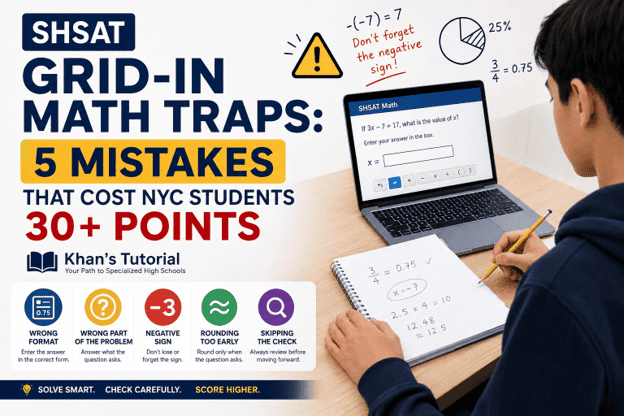
The SHSAT is one of the most important exams for NYC students seeking admission to a Specialized High School. Strong preparation requires more than knowing how to solve equations, work with fractions, or calculate percentages. Students also need to understand how to approach different question types and avoid preventable errors under test-day pressure.
Math questions can become especially challenging when a student must enter an answer instead of selecting one from multiple choices. A student may understand the mathematics but still lose a valuable point because of a calculation error, incorrect sign, rounding mistake, or failure to answer exactly what the question asks.
I encourage parents to look beyond how many questions a student gets wrong. The more important question is why the student gets them wrong.
Identifying recurring mistakes can help students improve accuracy, confidence, and overall SHSAT performance.
Grid-in and fill-in-the-blank math questions require students to take greater responsibility for the final answer. Instead of choosing from several options, students must solve the problem and provide the appropriate response.
That creates opportunities for avoidable mistakes.
I often tell students that getting the mathematics right is only half the job. They also need to make sure the final answer accurately reflects their work.
The phrase “30+ points” does not mean that every individual mistake carries a fixed 30-point penalty. SHSAT scoring does not work that way. However, several preventable mistakes can significantly affect a student’s overall performance.
Here are five common SHSAT grid-in math traps I recommend students learn to recognize before test day.
Table of Contents
- What Are the Most Common SHSAT Grid-In Math Traps?
- Why Do Students Make These Math Mistakes?
- How Can Students Avoid Losing Points on Grid-In Questions?
- How Should Students Practice SHSAT Grid-In Math?
- What Should Parents Look for During SHSAT Math Preparation?
- Frequently Asked Questions About SHSAT Grid-In Math
- Conclusion
What Are the Most Common SHSAT Grid-In Math Traps?
1. Entering the Wrong Answer Format
A student can solve a problem correctly but enter the answer incorrectly.
For example, a student may calculate that a value equals 0.75 but accidentally enter 0.075. The mathematical reasoning may have been correct, but the final response is still wrong.
I recommend that students always check the form of the answer before submitting it.
Students should ask:
- Does the question require a fraction?
- Does it require a decimal?
- Does it ask for a percentage?
- Does it require a whole number?
- Did I enter the number exactly as I calculated it?
This simple habit can prevent careless errors.
2. Answering the Wrong Part of the Problem
SHSAT Math questions can contain several pieces of information. A student may perform every calculation correctly but answer a different question from the one asked.
For example, a problem may ask for the remaining distance, while the student’s calculation determines the distance already traveled.
I recommend that students identify the final question before beginning their calculations.
At the end, they should ask:
“What exactly does the question want me to find?”
That short check can prevent an otherwise unnecessary mistake.
3. Forgetting a Negative Sign
Negative numbers are another common source of errors.
A student may correctly solve an equation and determine that:
x = -8
but enter:
8
The difference between the two answers is only one symbol, but mathematically it is significant.
I encourage students to pay special attention to negative signs when working with:
- Integers
- Coordinate planes
- Equations
- Inequalities
- Subtraction
- Algebraic expressions
Students should also remember that multiplying or dividing an inequality by a negative number changes the direction of the inequality sign.
4. Rounding Too Early
Rounding during the middle of a calculation can change the final answer.
For example, if a student calculates 8.67 and immediately changes it to 8.7, that rounded value may produce a different result when used in another calculation.
I recommend keeping exact values throughout the calculation whenever possible.
Students should round only when the question specifically requires it.
Before submitting an answer, I want students to check phrases such as:
- “Nearest whole number”
- “Nearest tenth”
- “Nearest hundredth”
- “Approximately”
- “Exact value”
The wording of the question tells the student how to report the answer.
5. Moving Forward Without Checking the Answer
The final trap involves rushing.
A student may finish a calculation, enter an answer, and immediately move forward without checking the response.
On the computer-based SHSAT, students need to understand the navigation rules for the Math section and practice working within the digital testing environment.
I recommend using a quick final check:
Solve → Check → Enter → Confirm
Students should verify:
- Did I answer the question that was asked?
- Did I enter the correct value?
- Does my answer make sense?
A few seconds of verification can catch a surprising number of careless errors.
Why Do Students Make These Math Mistakes?
Most students do not make grid-in mistakes because they are incapable of doing the mathematics. More often, the problem comes from rushing, misunderstanding the question, or failing to check the final response.
Time pressure can make this worse.
A student may know how to solve a percentage problem but move too quickly and enter a decimal incorrectly. Another student may understand algebra but forget to carry a negative sign through the final step.
I encourage parents to avoid labeling these errors simply as “careless mistakes.” That description does not tell a student how to improve.
Instead, I recommend identifying the specific cause.
Was the mistake caused by:
- Misreading the question?
- A calculation error?
- A sign error?
- Incorrect rounding?
- Incorrect answer format?
- Rushing?
- Lack of understanding?
- Failure to check the final answer?
Once I identify the pattern, I can address the actual problem rather than simply assigning more practice questions.
How Can Students Avoid Losing Points on Grid-In Questions?
I recommend that students develop a consistent process and use it on every practice question.
Use the Read–Solve–Check Method
Step 1: Read
Read the entire question before calculating.
Step 2: Identify
Determine exactly what the question wants.
Step 3: Solve
Work through the mathematics carefully and organize each step.
Step 4: Check
Review the calculation, signs, units, and requested answer format.
Step 5: Enter
Enter the answer carefully.
Step 6: Confirm
Before moving forward, make sure the response matches the question.
Keep an SHSAT Mistake Log
I strongly recommend keeping a mistake log during preparation.
For every missed question, students can record:
| Mistake Type | Example |
|---|---|
| Calculation | Arithmetic error |
| Sign | Forgot a negative |
| Reading | Answered the wrong question |
| Rounding | Rounded too early |
| Entry | Entered the wrong value |
| Concept | Did not understand the mathematical skil |
After several practice tests, the pattern becomes much easier to identify.
If a student repeatedly makes sign errors, I would focus on integer and algebra practice. If the student repeatedly answers the wrong question, I would focus on reading and translating word problems.
The goal is not simply to complete more questions. The goal is to make fewer repeat mistakes.
How Should Students Practice SHSAT Grid-In Math?
Effective SHSAT preparation should include both mathematical skill development and test-taking accuracy.
I recommend the following practice strategy:
Start With Accuracy
Students should first focus on solving problems correctly without worrying excessively about speed.
Introduce Timing Gradually
Once accuracy improves, students can begin practicing under time constraints.
Practice Different Question Types
Students should practice:
- Algebra
- Equations and inequalities
- Ratios and proportions
- Percentages
- Geometry
- Statistics
- Probability
- Word problems
- Multi-step problems
Practice on a Computer
Because the SHSAT has moved to a computer-based, adaptive format, students should become comfortable with the digital testing environment and available tools.
I recommend using official NYCPS practice resources whenever possible so students can become familiar with the testing interface and question formats.
Review Every Mistake
A practice test should not end when the score appears.
The most valuable part often comes afterward.
I recommend asking:
“Why did I miss this question?”
That answer can provide more useful information than the score itself.
What Should Parents Look for During SHSAT Math Preparation?
Parents do not need to teach every SHSAT math concept themselves. However, they can play an important role by helping students recognize patterns in their mistakes.
I recommend looking for these warning signs:
- The student understands the concept but repeatedly makes calculation errors.
- The student rushes through the final step.
- The student rarely checks answers.
- The student struggles with negative numbers.
- The student rounds numbers without reading the instructions.
- The student has difficulty translating word problems.
- The student performs well on paper but struggles with digital practice.
- The student’s mistakes repeat across multiple practice tests.
If the same mistake appears repeatedly, simply completing more practice tests may not solve the problem.
A targeted approach usually works better.
For example, if a student consistently loses points because of fractions, I would spend time strengthening fraction operations before returning to full-length timed practice.
If the student understands the content but rushes, I would focus more heavily on pacing and verification.
The right preparation strategy depends on the student’s individual error pattern.
Frequently Asked Questions About SHSAT Grid-In Math
1. What is a grid-in math question on the SHSAT?
A grid-in or fill-in-the-blank question requires the student to calculate an answer and enter the response rather than simply selecting an answer choice. Students therefore need to pay attention to both the mathematics and the final answer entry.
2. Can one careless mistake really cost 30 points on the SHSAT?
There is no fixed rule stating that one grid-in mistake automatically costs 30 points. SHSAT scoring does not assign a simple fixed number of reported points to each question. However, repeated mistakes can affect a student’s overall performance and reported score.
3. What is the biggest SHSAT grid-in mistake students make?
I would not identify one mistake as universally responsible for the most lost points. However, entering an incorrect final answer after completing the mathematics correctly is particularly frustrating because the student may have demonstrated the necessary mathematical understanding but failed during the final step.
4. How can my child improve SHSAT Math accuracy?
I recommend combining targeted math practice with a mistake log, timed practice, digital test practice, and a consistent answer-checking routine. Students should focus on correcting repeated weaknesses rather than simply completing a larger number of practice questions.
Conclusion
Strong SHSAT Math performance requires more than knowing mathematical formulas and solving difficult problems.
Students also need to protect the points they can reasonably earn.
Incorrect answer formats, negative-sign errors, premature rounding, misreading questions, and rushing through answer entry can all turn correct mathematical thinking into an incorrect response.
I encourage every parent to look at the pattern behind a student’s mistakes. If the same error appears repeatedly, that pattern provides a clear opportunity for improvement.
With focused practice, careful review, and a consistent strategy for solving and checking grid-in questions, students can become more accurate and confident on SHSAT Math.
For personalized SHSAT preparation and expert academic support, visit Khan’s Tutorial.