
Parents often ask me which SHSAT practice tests their child should be using.
It is a reasonable question with a frustrating answer. Most of what comes up in a search is not worth your child’s Saturday morning, and some of it is built around a version of the exam that no longer exists.
So here is the short version, before the detail.
The official practice tests come from NYC Public Schools, and you do not need an account to use them. A series of full-length attempts spread across a prep year beats six crammed into a fortnight. And most of the value sits in what your child does after the test, not during it.
One thing matters more than all of that, though. The SHSAT has changed, and not all of the practice material in circulation has caught up.
Table of Contents
- What Is an SHSAT Practice Test?
- Where Do the Official SHSAT Practice Tests Come From?
- Has the SHSAT Changed?
- How Can You Tell Good Practice Material From Bad?
- How Many SHSAT Practice Tests Should Your Child Take?
- How Should Your Child Sit a Practice Test at Home?
- What Do You Do With the Score?
- The Mistake I See Most Often
- Conclusion
- Frequently Asked Questions
What Is an SHSAT Practice Test?
The SHSAT is the Specialized High Schools Admissions Test. NYC Public Schools describes it as the sole factor used to determine admission to eight of the city’s specialized high schools.
That is why these practice tests matter more than practice material usually does.
A practice test is simply a copy of that exam your child sits before the real one. Two words come up constantly, and they are worth pinning down.
Full-length means both sections — English Language Arts (ELA) and Math — from the first question to the last, in a single sitting. A twenty-question worksheet is a drill, not a practice test.
Timed means the clock runs the way it will on test day. NYC Public Schools gives a standard test time of 180 minutes. In its practice-test instructions, the DOE tells students they may divide that time between ELA and Math however they want.
Where Do the Official SHSAT Practice Tests Come From?
NYC Public Schools publishes its practice material through the NYC SHSAT Portal, which it links from its own SHSAT page. The DOE says the tutorial and practice tests are accessible every year directly through a web browser.
The portal lists four full-length practice tests for students taking the test in grade 8 in the fall of 2026, and notes that two of them have new content for this year. There are also shorter mini practice tests for grade 9 students, meant to be used alongside the grade 8 tests.
| What the portal offers | What it is | What it is for |
|---|---|---|
| Four full-length grade 8 practice tests | Complete ELA and Math exams, taken in the browser | Your full-length attempts |
| Timed and untimed versions | The portal says to pick timed to simulate the standard three-hour administration, and untimed to simulate extended time or to review answers as you go | Timed for a real attempt; untimed for review |
| Printable PDF versions | The same tests as documents you can print | For preparing when a computer is not available |
| Answer explanations | Explanations of the correct answers for each practice test | The most valuable material on the site |
| Student Readiness Tool | A tutorial that lets students experience the functionality of the exam | Getting used to the screen, not studying content |
Three practical notes.
There is no account to create. NYC Public Schools says you do not need to log in or download an application to take the practice tests — and also that your answers will not be saved.
That second part matters more than it looks. When your child finishes, the portal says they are taken to a summary report identifying the items they answered correctly and incorrectly, and it tells you to click “Print this page” to print it or save it as a PDF if you want to refer back to it. Do that before anyone closes the tab. Together with the answer explanations, that report is your record of what to review.
The Student Readiness Tool is a tour of the software, not a study aid. The tool itself states that its sample items do not represent the content of the SHSAT.
And the portal warns that a practice test cannot be paused — it suggests using the untimed version if your child does not have three hours straight, so that progress is not lost.
NYC Public Schools also links a written guide from its “How to Prepare for the Specialized High Schools Admissions Test” page. At the time of writing it is labelled the NYC Guide to the SHSAT for 2027 Admissions — confusing until you know that the SHSAT is given in the fall for admission the following school year, so students testing in fall 2026 are seeking admission for September 2027.
Has the SHSAT Changed?
Yes, and this is the part that makes older practice books risky.
Beginning in fall 2026, NYC Public Schools says the SHSAT moves to a computer-adaptive test — often shortened to CAT. The DOE describes it as a test that adjusts its content based on student responses: answer correctly and the estimated score goes up and the next question may be more challenging; answer incorrectly and the next question may be less difficult.
A few reassurances, because this is where parents tend to worry.
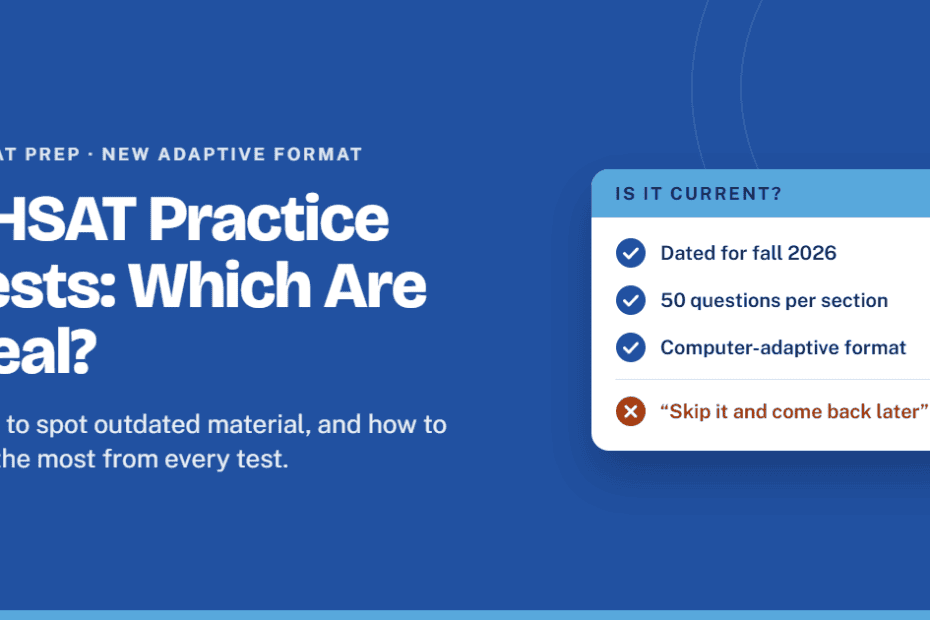
All students answer the same number of questions and are tested on the same grade-level standards. Each section has 50 questions, and the standard testing time is 180 minutes.
Here is the change that actually affects practice.
On the adaptive test, your child must respond to each question before moving on to the next. For Math questions and stand-alone ELA items, NYC Public Schools says a student cannot return to a question once they have advanced past it. Passage-based ELA sets are the exception: a student can move around within the set and change answers, but once the set is submitted, it closes.
Read that again, because it quietly kills a lot of familiar advice.
“Skip the hard ones and come back at the end” does not work here, except within a single ELA passage set. The content in an older book may still be useful. The pacing strategy in it may not be.
One more piece of familiar advice the DOE specifically warns against: racing through the last few questions to finish. In its words, as students near the end of their time “they should not assume that rapidly guessing on remaining questions in order to finish is preferable to making the best attempt on each item.” On an adaptive test, a considered attempt on a hard question is worth more than three rushed guesses.
If you want the detail on how that changes test-day tactics, I wrote about it in Computer-Adaptive SHSAT vs. Paper SHSAT: Strategy Adjustments NYC 8th Graders Must Make.
How Can You Tell Good Practice Material From Bad?
Start with the official tests. When you look beyond them — and many families do, because four tests will not fill a year — run this short check.
- Is it dated? Material that will not say which test year it was written for is telling you something.
- Does the structure match? The current test has 50 questions per section. A book showing a different count was not written for this version of the exam.
- Does it mention the adaptive format at all? Silence usually means it was written before fall 2026.
- Does it still teach skipping and coming back? On the current exam, that advice will not survive contact with the screen.
- Does it explain the answers, rather than only marking them right or wrong?
Be wary of anything promising a precise prediction of your child’s official score. No practice material can deliver that.
How Many SHSAT Practice Tests Should Your Child Take?
This is a judgment call rather than a rule, so here is my honest answer: roughly six to ten full-length tests across a prep year, with several weeks between them for most of that year.
| Stage of the prep year | Full-length tests | Why |
|---|---|---|
| At the start | 1 | A baseline. It will be a low score. That is the point. |
| Through the long middle stretch | 1 every 6–8 weeks | Enough time to actually fix what the last test found |
| Final six weeks | 1 every 2 weeks | Sharpening timing and stamina, not learning new content |
The gap between tests is the part people get wrong.
A practice test does not teach your child anything. It produces a list of things to work on, and working through that list takes weeks. Six tests in a fortnight produces six lists and no time to act on any of them. That is a discouraging fortnight for no good reason.
How Should Your Child Sit a Practice Test at Home?
A relaxed, untimed attempt at the kitchen table will produce a higher score and tell you very little. Three hours of sustained concentration is a real part of what the SHSAT asks for.
- One sitting, start to finish, with the timer running.
- Phone in another room.
- No notes, no textbook, no looking anything up.
- A quiet space, with the rest of the household warned in advance.
- Use the timed online version, and only begin when three clear hours are available.
Save the untimed version for going back through the test afterwards with the explanations open.
What Do You Do With the Score?
The number of questions your child got right is not the score that earns an offer. There is a chain in between.
NYC Public Schools says every item has an established difficulty, placed on a common measurement scale, and that a student’s performance score is calculated from their pattern of correct and incorrect responses in relation to that item difficulty. The DOE adds that converting performance scores into final reported scores works the same way it has in previous SHSAT administrations.
That matters more than it sounds. On an adaptive test, which questions your child answers correctly carries weight, not only how many.
| Step | What it means |
|---|---|
| Performance score | Built from the student’s responses, taking each item’s established difficulty into account |
| Scaled score | The performance score for each section, converted into the reported score |
| Composite score | The two section scores combined — the number used for admissions |
| An offer | Made in descending order of SHSAT score, combined with the student’s listed school preferences |
NYC Public Schools publishes the lowest qualifying SHSAT score for each of the eight schools that admit on the test. The figures on its enrollment page currently cover 2026 admissions — which, because the exam is given in the fall for admission the following school year, means the students who sat it in fall 2025. They are worth a look, but they describe one past year rather than a target.
And the honest part, in the DOE’s own framing: not all students who take the SHSAT receive an offer, and the specialized high schools do not have waitlists.
So resist the urge to convert a practice result into a verdict. Because scoring accounts for question difficulty, a count of correct answers is a rough position, not a prediction.
If you want to see roughly where a raw score sits, our free SHSAT score calculator will do the conversion for you. Treat what it gives you as a ballpark, for the same reason — it cannot know which particular questions your child got right.
The Mistake I See Most Often
Treating practice tests as practice.
They are not practice. They are diagnostics. The learning happens afterwards, in the review — and the review is the easiest step to skip, because it is slower and less satisfying than sitting another test.
Here is the review I ask for. Go through every wrong answer and sort it into one of three piles.
| Why it was wrong | What it looks like | What to do about it |
|---|---|---|
| Knowledge gap | Your child did not know the rule, the formula, or the word | Go and learn it. This is real studying. |
| Careless error | Your child knew it and misread, miscalculated, or chose the wrong option | Look for the pattern. These repeat. |
| Ran out of time | Rushed or unconsidered answers toward the end | A pacing problem, not a content problem |
Three wrong answers in three different piles need three different responses. A student who does more questions without sorting them is working hard in the wrong direction.
One hour of honest review is worth more than another three-hour test.
Conclusion
Start with the official material. NYC Public Schools publishes four full-length grade 8 practice tests for students testing in fall 2026, with answer explanations, in a browser, with no login.
Sit them properly — three hours, one sitting, no phone — and spread them across the prep year rather than stacking them at the end.
Check anything beyond the official tests against the current format. The test is now 50 questions per section, it is computer-adaptive, and your child must respond to each question before moving on, with very limited ability to go back. Material that has not caught up will teach the wrong habits.
Then spend real time on the review. That is where progress comes from, if it comes.
Frequently Asked Questions
Do I need an account to use the official SHSAT practice tests?
No. NYC Public Schools publishes them openly on the NYC SHSAT Portal and says you do not need to log in or download an application to take them. It also says your answers will not be saved, so print or save the summary report at the end.
Where can I find official SHSAT practice tests?
The NYC SHSAT Portal hosts the full-length practice tests, printable versions, and answer explanations. You can reach it from the SHSAT pages on the NYC Public Schools website.
Can my child use an older SHSAT practice book?
The content may still be useful. The strategy advice may not be. If it tells your child to skip hard questions and come back to them later, that does not fit the current exam — on the computer-adaptive SHSAT each question must be answered before moving on.
Does a practice test score predict the real score?
Not precisely. Scoring takes the difficulty of each item into account, so a count of right answers is only part of the picture. Treat a practice score as a rough position.
How many practice tests should my child take before the SHSAT?
I suggest roughly six to ten full-length tests across a prep year, spaced several weeks apart, with serious review between them. More tests with less review is the worse trade.
If you would like your child working through full-length practice tests on a steady schedule, with the review built into the week rather than left to chance, that is how our SHSAT classes are structured.